 GrailVinyl
How to read the dead wax on a vinyl record
The run-out groove holds the codes that reveal your record's exact pressing — and whether it's an original or a reissue. Here's how to decode them.
What is the “dead wax”?
The dead wax — also called the run-out groove, run-out, or matrix area — is the smooth band of vinyl between the final track and the centre label. It looks blank, but lean it under a light and you'll find characters stamped (machine-pressed) or hand-etched into it. Those characters are how the people who cut and pressed the record signed their work, and they're the single most reliable way to identify which pressing you're holding.
Where to find the codes
- Hold the record at an angle under a bright, raking light and slowly rotate it.
- Look in the smooth ring just outside the label, on both sides (Side A and Side B can carry different stampers).
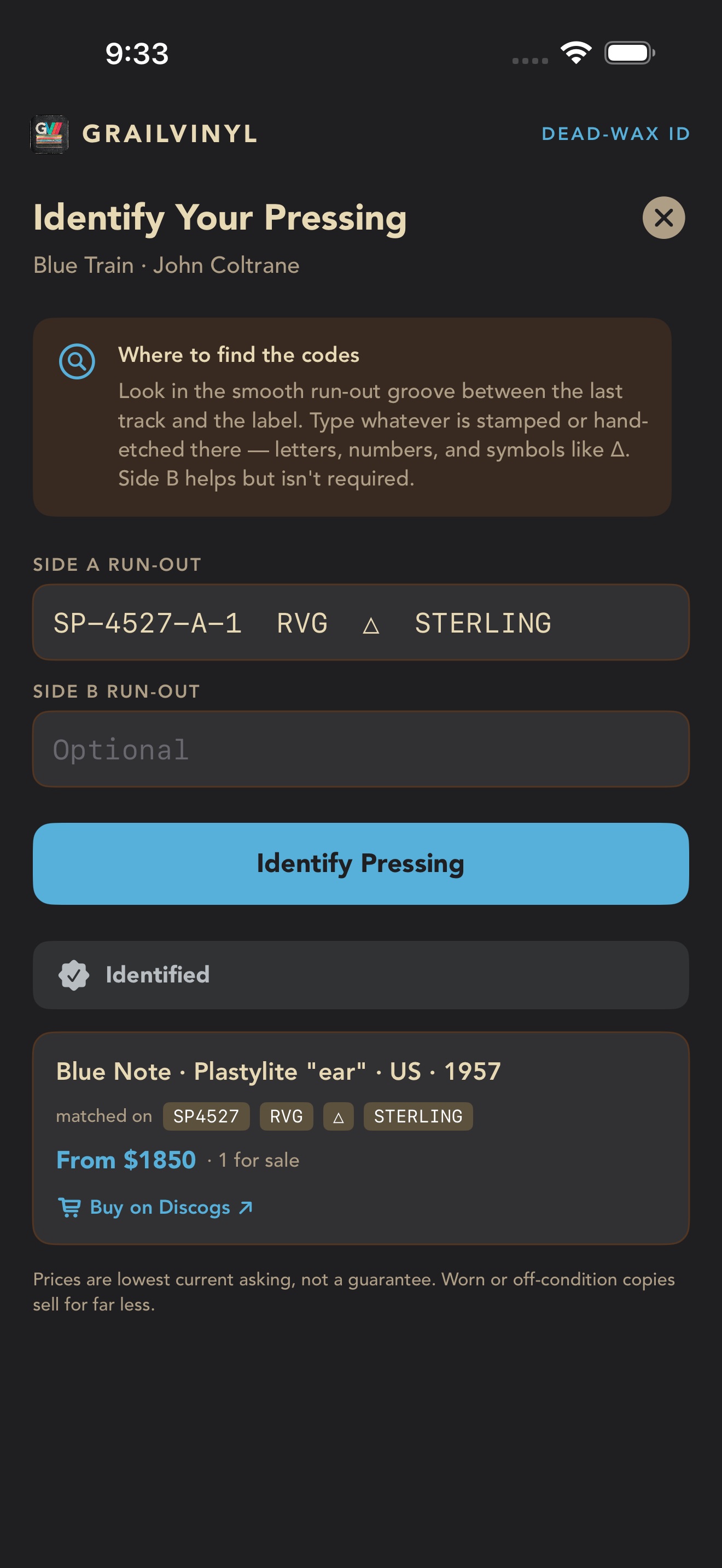
- Expect a mix of letters, numbers, and symbols — e.g.
SP-4527-A-1, a triangle△, or words likeSTERLING.
What the codes mean
| Mark | What it tells you |
|---|---|
| Matrix / catalog number | The master identifier for that side. Usually the strongest clue to the release and country. |
Trailing -1 / -A / stamper letters | Which set of metal parts pressed this copy. Lower/earlier often (not always) = earlier pressing. |
Engineer initials — RL, Porky, STERLING, RVG | Who mastered it. Robert Ludwig, George Peckham, Sterling Sound, Rudy Van Gelder — some cuts are prized for sounding better. |
Symbols — the Plastylite “ear” △ | Pressing-plant marks. The Plastylite ear, for instance, signals an original Blue Note pressing. |
Using the dead wax to spot an original vs. a reissue
No single mark is decisive — pressing identification is a weight of evidence. A genuine original usually lines up across several signals at once: the right matrix, the period-correct stamper, the expected mastering initials, the correct pressing-plant symbol, and matching label/sleeve details. A reissue or counterfeit typically gets one or two of these wrong. The codes in the dead wax are where the trail starts.
Skip the cross-referencing
Typing matrix numbers into forums and spreadsheets is slow. GrailVinyl lets you type the run-out codes you see and instantly matches them against every known pressing — then tells you the exact pressing, where it was made, and what it's worth.
Get GrailVinyl — free on the App StoreOn-device identification & catalog · no account required
Quick FAQ
What is the dead wax on a vinyl record?
The smooth, ungrooved band between the last track and the label. The matrix number, stamper codes, engineer initials, and plant marks etched there identify the exact pressing.
How do I tell if my record is a first pressing?
Read the matrix number and compare it to known first-pressing matrices for that release; a trailing -1 or -A often signals the first metal parts. Confirm with the mastering initials, pressing plant, and label details. GrailVinyl does this matching for you.
What do the initials in the dead wax mean?
They're usually the mastering engineer's signature — RL (Robert Ludwig), Porky (George Peckham), STERLING, RVG (Rudy Van Gelder). Specific cuts are prized for their sound.